Overview
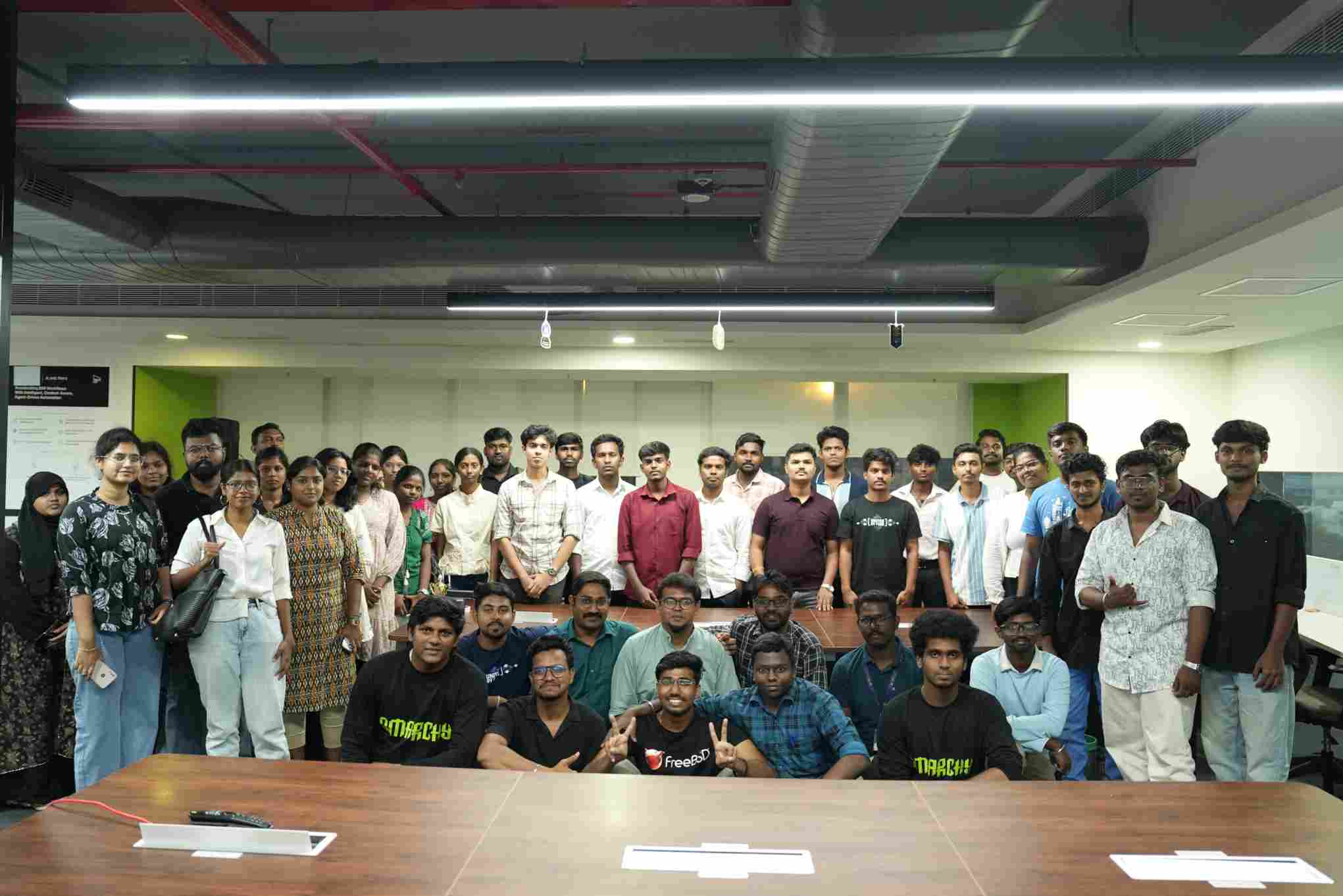
On Saturday, 19th September 2026, I represented the Fedora Project at the FOSS United Chennai Community’s September meetup. My talk proposal got accepted, so I attended the event as a speaker.
My talk focused on introducing Forgejo: how I got into the project, how Fedora migrated from Pagure to Forgejo, the benefits we’ve seen, and my journey contributing to upstream Forgejo as one of the first few Fedora contributors to do so.
Talks
Since it was a half-day event, FOSS United Chennai approved five talks for the day:
NixOS, Open Source, and the Future of Reproducible Infrastructure
- Vivekanandan KS
- Sriram S
- Vijay Ganesh
- Prasanth Baskar
Dify: Build AI Workflows - No Code
- Sivakumar Vadivel
PyTamil - Converting the Official Python documentation into Tamil
- Madhan Kumar S
- Yashwanth Rathakrishnan (me)
It’s Just A Video Call… Right? Understanding WebRTC Under the Hood
- Shane Cardoz Maria
A Big Fumble
The Build-Up and Timing
My talk was about Forgejo,how Fedora adopted it to solve the pain points we had with Pagure, why it’s a solid alternative to GitHub, and why folks should consider self-hosting.
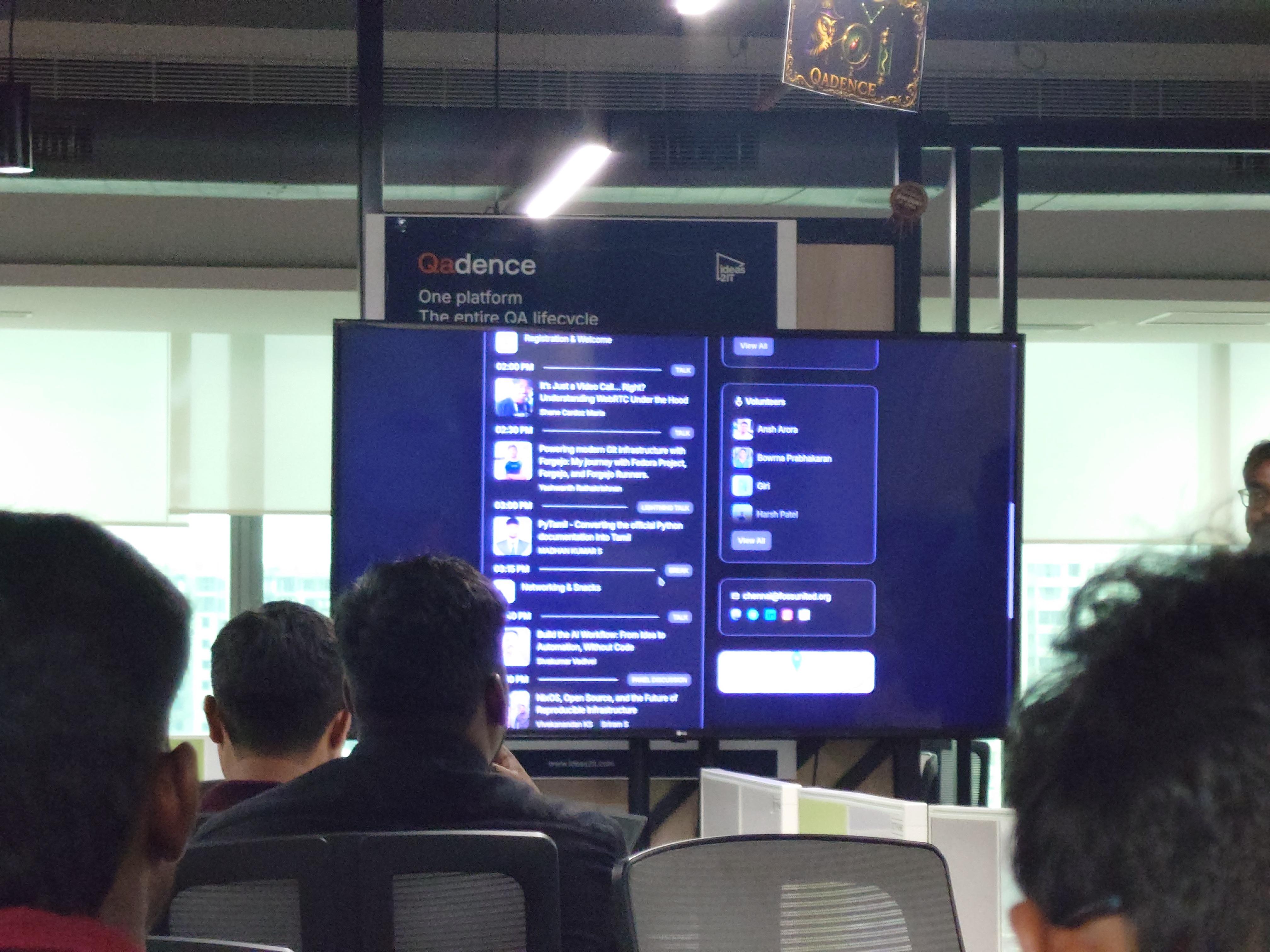
My talk was scheduled at 14:30
My session was right after Shane Cardoz Maria’s talk, It’s Just A Video Call… Right? Understanding WebRTC Under the Hood. His talk really caught my attention. Back in 2021, I had a great experience using Google Duo,it had good video quality even on bad internet connections, much better than WhatsApp did at the time. I asked a question during the Q&A and learned that WebRTC was originally a Google project, which finally explained why Duo worked so well.
Because it was a deep technical talk, it ran slightly over time. Shane wrapped up around 14:40, even though my talk was scheduled to start at 14:30. That left me with barely ~20 minutes.
Display Troubles and Workarounds
When I was called up, things immediately went wrong with the display. The room had an LG TV, but it wouldn’t mirror my screen. My laptop detected the TV, but no feed showed up on the display. We tried a second laptop, still no luck. Then we grabbed a third laptop, started a Google Meet, and shared my screen so the third laptop could output it to the TV. Even then, the screen kept flickering, which was distracting and made me even more nervous.
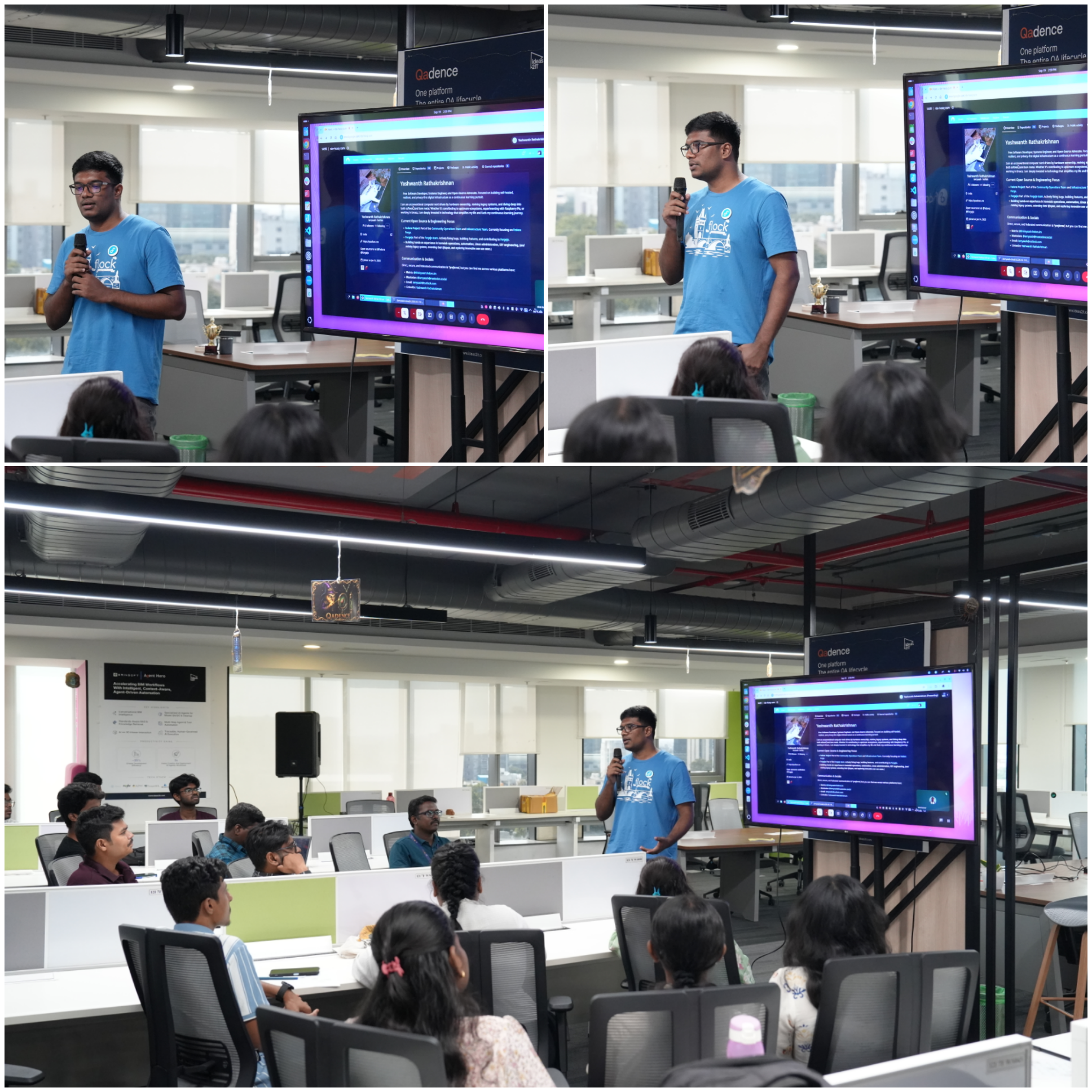
Workaround to share screen on TV via Google Meet
The Live Demo Mistake
Since it was my first time speaking publicly, I wasn’t sure how to handle the situation calmly. With time running out, I felt rushed to finish quickly so the next speaker wouldn’t lose their slot. Under pressure, I skipped straight to the practical side: a live demo showing how to run Forgejo and Forgejo Runner locally using Docker Compose.
That’s where the big fumble happened.
I was holding a microphone in one hand, typing with the other, and leaning down because the desk was way below waist height without any laptop stand. While saving the Docker Compose file, I accidentally left an extra colon (:) at the end of a volume path while saving the compose file (I was using nvim). When I ran the compose file, it threw this error:
      volumes:
        - ./forgejo:/data:
        - /etc/localtime:/etc/localtime:ro
service volume services.server.volumes.[0] is missing a mount target
My brain completely froze. I had tested the VMs beforehand and prepared for unexpected errors, but I couldn’t see what was wrong in that moment. I had copy-pasted the snippet from the docs and assumed the syntax was fine without checking the end of the line. It was just a simple typo, but nobody in the room spotted it either.
The irony is that I actually had pre-recorded backup videos ready on my laptop for this exact reason. But with the rush, the flashing TV screen, and the mounting pressure, my mind went blank and I completely forgot I even had them.
Balancing the mic, hunching over the desk, and racing against the clock, I was overwhelmed. After about 3-5 minutes of struggling, Prasanth Baskar stepped in and politely suggested wrapping up so we could keep the schedule moving. I had to step down and debug it on my own afterward.
It was definitely a trial by fire. I prepared for complex technical failures, but a tiny typo tripped up my first presentation. Lesson learned: I’d only feel bad if I repeated it, but I’ll make sure not to make that mistake again.
Dealing with the Aftermath
The demo mistake really affected my mood right after. I could not stop replaying the error in my head and wondering how I missed such a simple typo. For about half of the remaining event, I was physically in the room, but my mind was completely somewhere else.
Highlights Beyond the Fumble
Finding Out How WebRTC Works
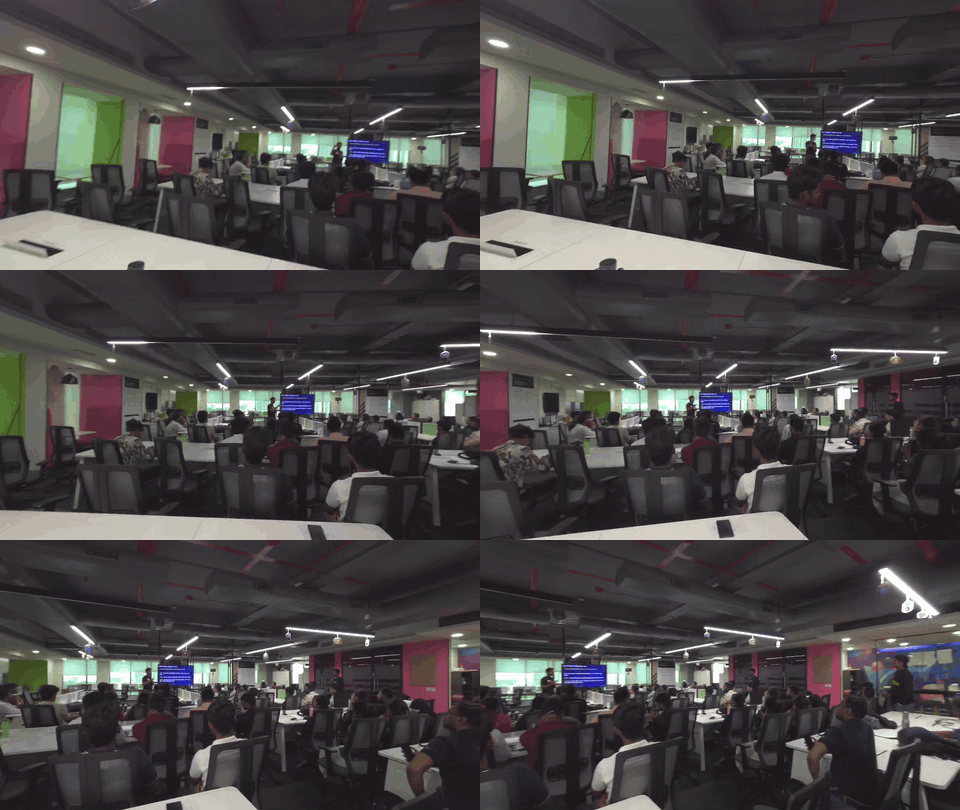
Shane’s talk on WebRTC caught my interest right away. While I am not planning to write code for the project anytime soon, learning that a technology behind so many everyday video calls is open source and actively maintained was great to see. Even if I cannot contribute technically, I will definitely talk about it with friends and peers. Spreading the word is sometimes the best way to help solid open-source software get the attention it deserves.
Talking with Attendees About Fedora
A lot of people came up to me during the breaks with questions about the Fedora Project. Most were curious about how I got started and were surprised to meet a Tamil contributor representing upstream Fedora. A few people came over asking for help with issues on their own Fedora setups,and since they used the same hardware as me, I was able to tell them what went wrong right away. Others asked simple questions like why they should pick Fedora Linux for their daily use. Mostly, it was great answering their doubts and helping point them in the right direction to get involved.
Looking back, I really wish I’d taken some pictures with the attendees. My mind was still so stuck on replaying the demo fumble that I forgot to capture those moments.
Understanding NixOS vs. Ansible
The last talk was a panel discussion on NixOS, Open Source, and the Future of Reproducible Infrastructure. It really got my curiosity going. I have wanted to try Nix and Nix packages for a while, but I had a lot of doubts holding me back. I used to think Nix was just like Ansible, but the talk helped me see that they work very differently under the hood. While you might use both to set up a machine, their way of handling system setups is totally different. Even more than NixOS itself, Nix packages have been on my list to learn, especially since Fedora Linux 44 has built-in support for them. This panel was the final push I needed to start playing around with it.
Missing Out On Swag
One detail I wasn’t able to plan properly was getting Fedora swag for the event. The process requires opening a ticket with Fedora Mindshare, but by the time I realized it, it was already too late. Had I reached out earlier, Samyak and Akashdeep could have easily routed an extra box to me since they had just placed an order for another event. Since this was my first time representing Fedora, I’m taking it as a lesson learned. For the next meetup, I’ll definitely initiate the request much sooner so attendees don’t leave empty-handed.
Bringing More Fedora to Tamil Nadu
The biggest thing I noticed was the lack of Fedora Project representatives across Tamil Nadu. Beginners who know a little about Fedora often think it has a very high barrier to entry and that it is too hard to start contributing. Several people told me that I should keep attending local tech meetups, event, conferences and stay visible. Prasanth Baskar specifically encouraged me to show up at more events across Tamil Nadu to introduce Fedora to as many people as possible. It showed me that there is real interest here, and I want to do my part to help grow the local community.
Dinner!
Hanging Out with the Last Few Folks
After the event wrapped up, a few people were still standing around and talking. We ended up being the last group left, so we decided to head over to SS Hyderabad Biryani for dinner.
It took us around 20-30 minutes to get there. Once seated, the conversations naturally drifted back to open source, along with a few controversial topics currently making rounds in the community. I was especially keen to talk about databases with Shane, who clearly has a ton of experience in that area. While I only know the fundamentals, Shane broke down practical scenarios of when to actually reach for PostgreSQL, which gave me plenty of ideas for my small-projects which I’m building with AI.
Eating After a 16-Hour Fast
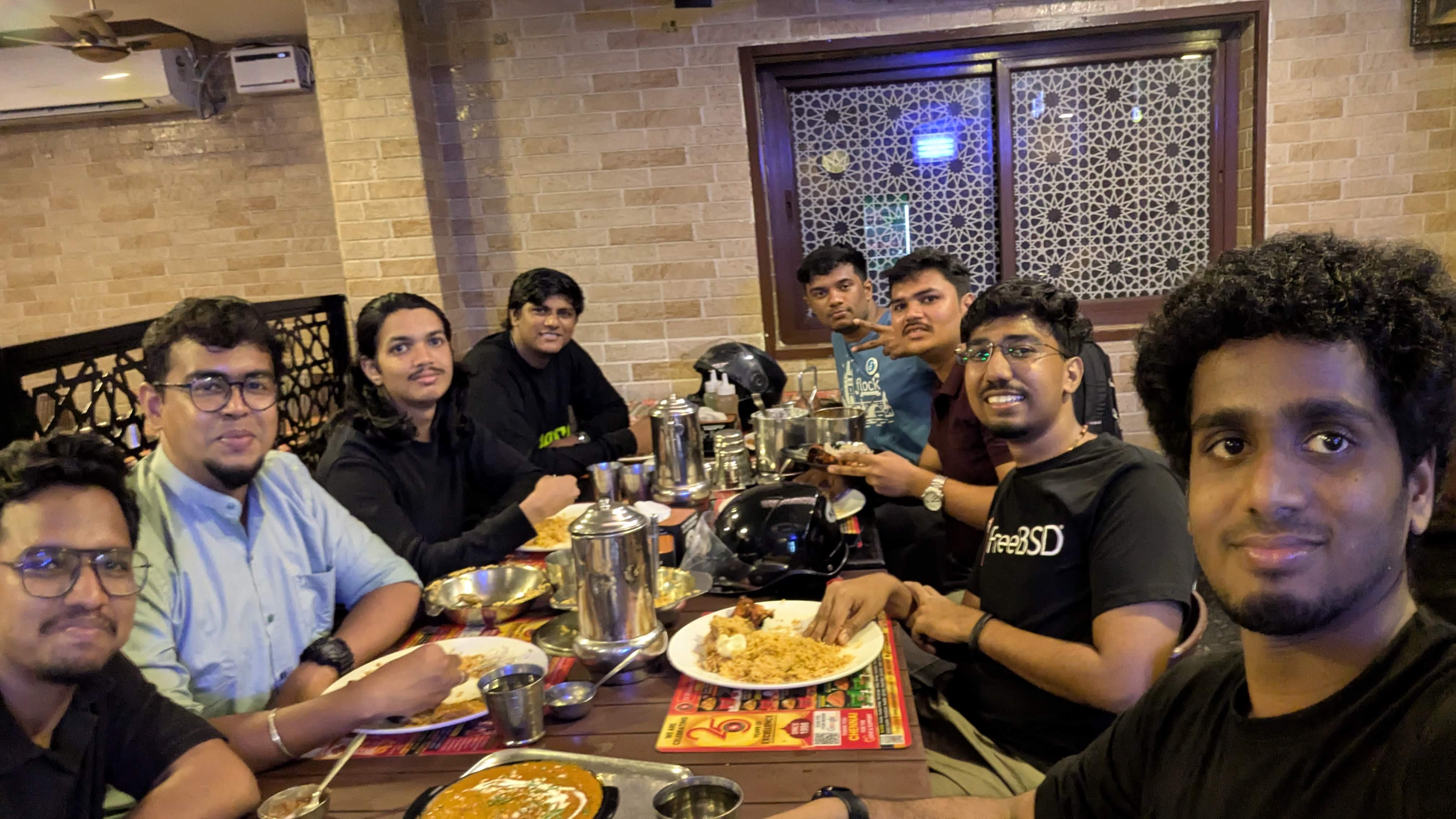
Food finally arrived after a long 16-hour day. I was completely tired and exhausted, and you can definitely see it on my face.
I had reached Chennai early that morning around 5:00 AM and accidentally ate something that smelled completely off. It made me feel sick and nauseous for the rest of the day, so I couldn’t bring myself to eat another bite until dinner. Looking back, I gave my first-ever presentation completely on an empty stomach with a bad stomachache. I honestly can’t believe I got through it, but having warm food in front of me at the end of such a chaotic day felt amazing.
A Spontaneous Distro Photo
After finishing dinner, I went to wash my hands along with Shane and Lakshmanan. That’s when Prasanth noticed that the three of us were wearing t-shirts representing three completely different distros: FreeBSD, Omarchy, and Fedora.
He immediately insisted on taking a picture of the three of us together. It turned into a funny moment with plenty of laughs because the Fedora logo on my Flock to Fedora 2025 t-shirt was printed on the back. To get all three distro logos lined up in one frame, I had to turn completely around for the camera!
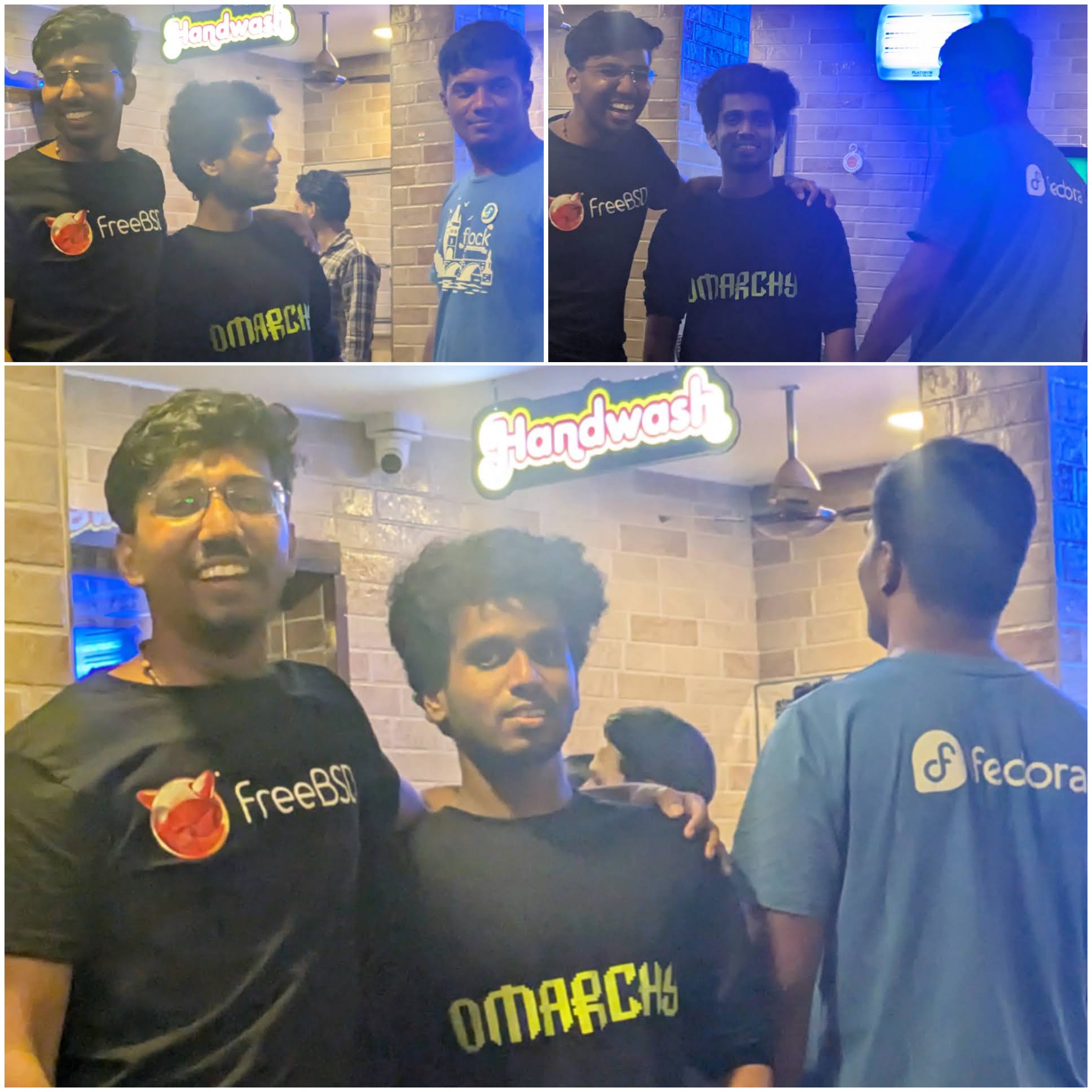
Lining up the distro shirts for a group shot. Since the Fedora print on my Flock 2025 t-shirt was on the back, I had to turn around for the photo.
Conclusion
Apart from my demo mess-up, I was genuinely inspired by how much open-source interest there is in Tamil Nadu. A lot of people were surprised to see a Tamilian representing the Fedora Project.
Right after it happened on the 19th, I thought to myself: maybe public speaking isn’t for me. But sleeping on it changed my mind completely. It actually sparked my curiosity to do more. I want to step out of my comfort zone, stay active in the local tech scene, and make a conscious effort to participate in upcoming events, meetups, and conferences across Tamil Nadu. My goal going forward is to consistently show up, represent the Fedora Project on the ground, and introduce more people here to Fedora, Forgejo, and the open-source world. This was just the first step in Tamil Nadu, and I know I’ll do much better next time.
Note on AI: Written by me; lightly edited with AI for grammar, typo fixes, flow, and markdown formatting.